
The Impact of Seat Gauge & Stage Length on RASM
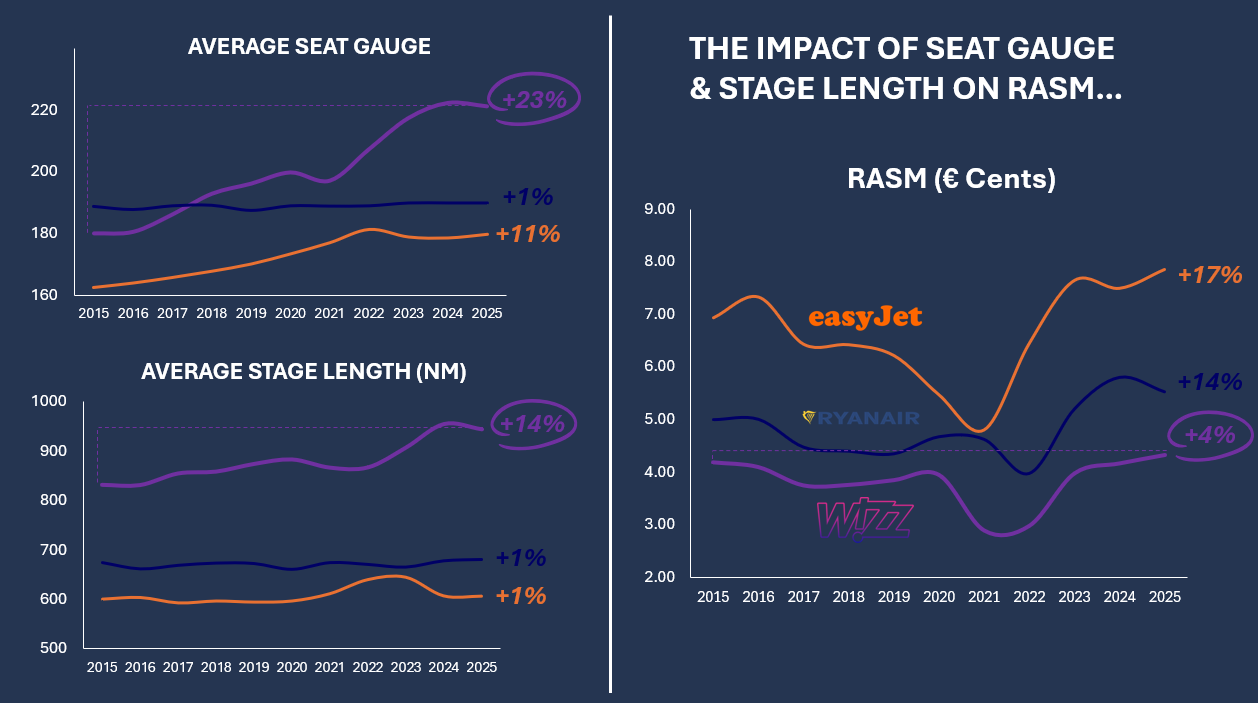
Revenue per Available Seat Mile (RASM or RASK) is a key metric used across management teams to determine airline performance. In isolation, it is unable to provide insight into an airline’s profitability. As such, RASM is often compared with the metric sitting on the other side of the equation: cost, expressed in CASM.
Understanding the decisions which impact RASM is vital in airline management. Two variables, in particular, which heavily impact on the performance of this metric and are in direct control of airline management teams are analyzed further:
𝗦𝗲𝗮𝘁 𝗚𝗮𝘂𝗴𝗲: There is an inverse correlation between the number of seats on an aircraft & associated yields per passenger. As seat count increases, the direct outcome is lower yields per passenger. This, ultimately, is a consequence of an airline selling more discounted seats to fill the larger aircraft.
Upgauging through larger aircraft has been a global industry phenomenon. This, however, has been driven by a focus on CASM, which declines with larger aircraft. Intense airline competition has been the primary source driving this focus.
Amongst Ryanair, easyJet & Wizz Air, only the latter aggressively ungauged over the past 10 years, transitioning its fleet from A320s to a predominantly A321 Family fleet and increasing seat capacity by 23% per flight. The former have maintained exemplary capacity control.
𝗦𝘁𝗮𝗴𝗲 𝗟𝗲𝗻𝗴𝘁𝗵: Similar to seat gauge, there is an inverse correlation between stage length and yields per passenger. Ultimately, ticket prices rise sub-linearly with distance as passengers perceive trips as single journeys. If, for example, a 500km flight costs $250, a passenger would be unwilling to pay $750 for a 1500km flight.
Both easyJet & Ryanair have maintained their average stage lengths, whilst Wizz Air has increased it by 14%. Saturation of markets and competition encourage airlines, such as Wizz Air, to expand route networks in search of untapped markets, often leading to higher average stage lengths if focus is lost.
𝗧𝗵𝗿𝗲𝗲 𝗔𝗶𝗿𝗹𝗶𝗻𝗲𝘀, 𝗧𝘄𝗼 𝗙𝗹𝗶𝗴𝗵𝘁 𝗣𝗮𝘁𝗵𝘀: As evidenced, Ryanair & easyJet have controlled seat gauge & stage length in exemplary fashion, setting the scene for a positive RASM story. In contrast, Wizz Air executed an aggressive fleet transition/upgauge, combined with a lack of route network focus, generating strong tailwinds for RASM. Without inflation, the airline's RASM evolution would be highly negative.
As we fly into the future, RASM will continue to be under pressure as airlines add larger gauge aircraft (easyJet & Wizz Air: A321N / Ryanair: B737M8-200) and core markets become increasingly saturated. A RASM success story is contingent on understanding the forces above and executing with focus.
